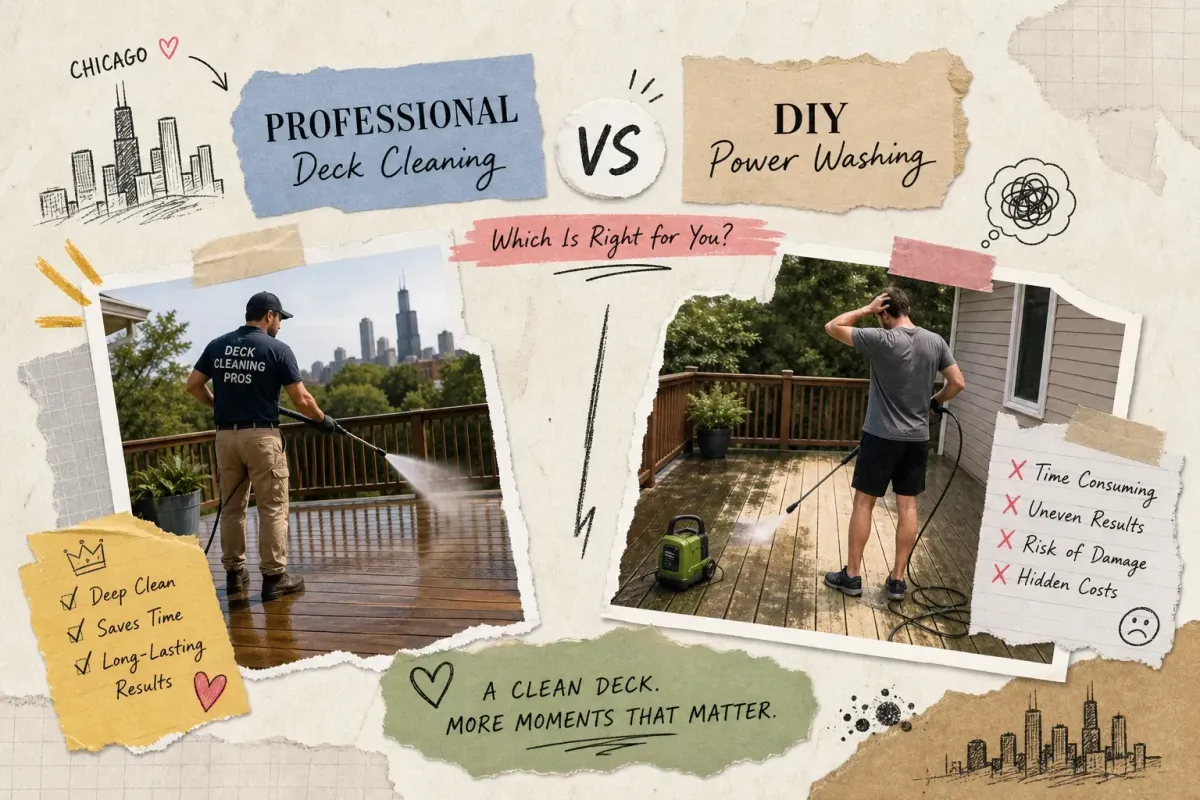
Deck Cleaning Services vs DIY Power Washing: Which Is Right for Your Chicago Deck
Every spring in Chicago, homeowners pull out a pressure washer they bought three years ago and blast their deck with zero preparation. Some get away with it fine. Many end up with raised grain, streaks, or wood that absorbs stain unevenly for the next two seasons. Whether to hire professional deck cleaning services or tackle the job yourself sounds like a simple question, but the honest answer depends on what your deck is made of, how it's currently aging, and what you're actually trying to accomplish.
We're a family-owned business that has cleaned and sealed over 12,000 decks across Chicagoland since 1995. This article walks you through the real comparison: method, cost, results, and how to find someone trustworthy if you decide to go the professional route.
What Chicago's climate does to an unprotected wood deck
Chicago winters are not just cold, they are wet and cold, which is the most destructive combination for wood. Water seeps into the wood grain, freezes, expands, and forces the fibers apart. Repeat that process 40 to 80 times in a single winter and you end up with cracking, splitting, and boards that start to cup or warp. A properly applied penetrating sealer creates a barrier that slows this cycle dramatically.
Most decks in the Chicago area need professional cleaning and resealing every two to three years. UV exposure fades the stain, moisture breaks down the sealant layer, and by year three most decks are absorbing water instead of repelling it. The problem is that the damage looks gradual, so homeowners push the timeline. By the time the deck looks visibly bad, the wood has already been compromised for a full season.
Want to understand exactly how moisture affects your deck? Read our guide on Deck Waterproofing in Chicago: Why It Matters More Than You Think.
Neglected decks don't just look bad; they get structurally weaker, and boards that have cycled through enough freeze-thaw damage may need replacement rather than restoration. A full deck restoration service costs significantly more than regular cleaning and sealing on schedule. Deck replacement costs more than either. The math strongly favors staying on schedule.
Pressure washing vs. soft washing: matching the method to your deck material
Wood decks and composite decks respond very differently to water pressure. A deck power washing service at the right PSI is effective and appropriate for sound wood. Composite decking is more sensitive, too much pressure can mark, streak, or scratch the surface, and some manufacturers include pressure washer restrictions in their warranty terms. Knowing your deck material before picking a method is not optional.
For wood deck cleaning, 2,500 PSI with a fan-tip nozzle is the professional standard used by experienced crews. The fan-tip distributes pressure across a wider area instead of concentrating it in a narrow stream, which avoids gouging the wood or raising the grain. Using the wrong nozzle is one of the most common DIY mistakes, the surface damage it causes shows up clearly once stain goes down.
Soft washing relies on lower water pressure combined with cleaning solution rather than brute force. It's the better call for older decks with weathered or softer wood and for composite surfaces. It takes longer and may require more brushing, but it won't fray wood fibers or put composite surfaces at risk. Matching the method to the material is the difference between a clean deck and a damaged one.
Not sure if your deck should even be power washed? Our article on Chicago Deck Power Washing: When It Helps and When It Can Damage Your Deck explains when pressure washing is the right choice and when it can do more harm than good.
How deck cleaning services work: what a professional job actually includes
A professional deck cleaning service starts with a thorough power wash at controlled pressure to remove dirt, algae, mildew, and old surface coating. Professionals also address the gaps between boards where debris collects and mold tends to grow. This prep work is not optional. Applying a sealer over a dirty or greasy surface traps the contamination underneath and the finish fails early.
After the deck dries, typically 48 to 72 hours depending on weather and shade exposure, the staining and sealing process begins. We use Rymar Wood Sealer, a USA-made penetrating sealer applied with multiple brush sizes to maximize wood absorption. A penetrating sealer works from the inside out, which provides longer-lasting protection than a surface coating that sits on top of the wood and peels over time.
After a professional deck restoration service, the wood should look uniformly stained and feel sealed to the touch within 24 to 48 hours. Color will even out as the sealer fully cures. Keep foot traffic off the deck for at least 24 hours and avoid dragging furniture across the surface until the sealer has hardened completely. That small window of patience protects the result for years.
What professional deck cleaning services cost in Chicago, and what moves the price
Professional deck washing services run between $0.30 and $0.70 per square foot for cleaning alone, with most standard jobs falling in the $100 to $350 range depending on size. A 300-square-foot deck usually comes in around $100. A 700-square-foot deck lands closer to $200 to $300. For the Chicago metro area, combined cleaning and sealing typically runs $1.50 to $4.00 per square foot, that's the service that actually provides lasting protection. These figures reflect the range we see across Chicagoland jobs.
If you're wondering when your deck should actually be cleaned and resealed, check out our guide on When Is the Best Time to Clean, Seal, or Stain Your Deck in Chicago?
Deck condition is the biggest variable in pricing. A deck covered in heavy mildew, peeling old stain, or gray weathered wood takes more time and product than one maintained on schedule. Access matters too: multi-level layouts, condo buildings with shared staircases, and porches that require extra crew setup all add hours to the job. A deck that's been deferred for four or five years will almost always cost more to restore than one serviced on a two-to-three-year cycle.
The honest DIY cost comparison is tighter than most people expect. A pressure washer rental, the right fan-tip nozzle, a quality penetrating sealer, brushes, and cleaner solution add up fast. Factor in your time, the learning curve on nozzle technique, and the real risk of surface damage, and the price gap between DIY and professional deck cleaning services narrows considerably for most homeowners. The protection gap, on the other hand, stays wide.
How to hire a deck cleaning company you can actually trust
Before booking anyone, ask every company the same core questions, it keeps the comparison honest and the answers tell you more than any online review.
Do you carry general liability and workers' compensation insurance?
What PSI and nozzle type do you use for wood decks?
What sealer products do you use, and are they penetrating or surface-coating?
Do you offer a written satisfaction guarantee or workmanship warranty?
Can you provide references or before-and-after photos from local projects?
Any company that hesitates on the insurance question or can't name their product is worth skipping. Reputable deck washing services offer at least a one-year workmanship warranty covering peeling, flaking, or failure of the applied coating under normal conditions. A satisfaction guarantee means the company will return and correct the work if the result doesn't meet expectations. Get these commitments in writing with clear terms before work starts.
A company with decades of local experience, an A+ BBB rating, and flat transparent pricing is easier to trust than an out-of-area crew quoting a number that seems too low to cover the actual work. We've served homeowners, condo associations, and property managers across Chicagoland since 1995, with free estimates and no hidden fees as standard practice. That makes it straightforward to compare the actual scope of work before committing to anything.
What to do between professional visits to keep your deck in good shape
Walk your deck every spring and look for boards that are cracking, cupping, or showing gray weathered wood in patches. Check the gaps between boards for debris and standing moisture. Inspect any railings or stairs for loose fasteners. Catching small issues early keeps them from becoming structural ones before the next professional service.
For routine maintenance between visits, a solution of oxygen bleach (sodium percarbonate) mixed with warm water is effective on algae and mildew without damaging the wood or harming surrounding plants. Avoid chlorine bleach on wood or composite surfaces, it can discolor the material and damage nearby landscaping. Rinse thoroughly and keep pets off the deck until it dries completely. The same caution applies to composite deck cleaning: gentler solutions protect the surface finish that factory coatings rely on.
If water is no longer beading on the surface of your deck, the sealer has worn through and the wood is absorbing moisture. That's the clearest signal to call for deck cleaning services before the next freeze-thaw season causes damage. Gray, silvery wood and soft or spongy boards are signs the restoration window is closing. At that point, waiting costs more than acting.
The bottom line: deck cleaning services vs. DIY power washing
For most Chicago homeowners with a wood deck, professional deck cleaning services every two to three years is the smarter financial and practical choice. DIY power washing without the right pressure, nozzle, and sealer can accelerate damage rather than prevent it. The cost difference between professional service and true DIY is smaller than most people expect, and the protection gap is significant.
If you're not sure where your deck stands, start with a free estimate. We provide upfront flat pricing with no surprise charges, and our crew has been doing this work in Chicago since 1995. Whether you manage one back deck in Lincoln Park, a property in Evanston, or a multi-unit building anywhere across the suburbs, the process is the same: clean it right, seal it with a quality penetrating product, and protect your investment before Chicago's next winter gets a chance to work on it. If you've been searching for reliable deck cleaning near me in the Chicagoland area, reach out directly for a no-obligation quote and see exactly where your deck stands.
Frequently asked questions about deck cleaning services
How long does a deck cleaning service take?
Most standard residential decks, 300 to 500 square feet, take three to five hours for the cleaning portion. Add another half day for sealing once the wood has dried, typically 48 to 72 hours later. Larger multi-level decks or heavily weathered surfaces take longer. We'll give you a clear time estimate before work begins.
Does pressure washing damage composite decking?
It can, yes. High-pressure washing can streak, scratch, or mark composite surfaces, and some manufacturers will void the warranty if certain PSI thresholds are exceeded. Composite deck cleaning should use lower pressure and appropriate cleaning solution rather than straight power washing. Always check your deck manufacturer's guidelines before scheduling any washing service.
How do I find deck cleaning services near me in Chicagoland?
Look for companies with verifiable local history, proof of insurance, and named product lines rather than vague promises. Chicagoland Deck Cleaning & Sealing serves Lincoln Park, Evanston, the North Shore, the western suburbs, and communities throughout the greater Chicago metro area. Free estimates are available with no obligation.
